Saturday, September 29, 2012

US STOCKS TUMBLE AFTER COMMENTS BY FED

AAP September 26, 2012
A FEDERAL Reserve official's doubts about the impact of the QE3 stimulus have pulled the rug from under US stock markets, sending them lower after strong early gains.
The Nasdaq tumbled as major tech stocks sank, with Apple falling 2.5 per cent, Oracle 2.8 per cent, Facebook 2.4 per cent and eBay 2.6 per cent.
At the closing bell the Dow Jones Industrial Average was down 64.87 points (0.48 per cent) at 13,494.05.
The S&P 500 lost 15.12 (1.04 per cent) at 1441.77.
The Nasdaq Composite shed 43.05 points (1.36 per cent) at 3117.73.
Markets opened higher on encouraging data on housing prices and consumer confidence.
But in afternoon trade, comments by Charles Plosser, head of the Fed's Philadelphia branch, appeared to spark a selloff.
Plosser said he was doubtful the QE3 bond-buying program announced earlier this month would have great impact on charging up the US economy, and warned that the Fed could lose credibility.

Tuesday, September 18, 2012

ECONOMIC RATIONALISM HAS NOT FAILED.

Ted Trainer
I am increasingly annoyed at people concluding that economic rationalist policies, or the World Bank's Structural Adjustment policies, or the free market or financial deregulation have failed. If that's what you think then you fail to understand the economic world. You must be assuming a) that the policies were intended and designed to meet the needs of people and the environment, b) that those framing and implementing them are bungling idiots because their strategies somehow always end up devastating the lives of most people and the ecosystems of the planet.
The patently obvious fact is that these policies have been stunningly and astronomically successful. The world economy is run by and for the benefit of a tiny group of extraordinarily rich and powerful people. They determine what will be done primarily through their capacity to invest in those ventures that will be most profitable to themselves. They have no interest whatsoever in the welfare of the people in general or of the planet . (Indeed as David Korten explains in When Corporations Rule the World, any corporation that devotes resources to good causes risks a lower rate of return and therefore opens itself to hostile takeover.) In the past 20 years they have been able to grab unprecedented power and freedom to go anywhere and do anything they wish, greatly assisted by governments whose advisers have had their minds warped by the study of conventional economic theory which takes it for granted that increasing business turnover and the GDP is all that matters.
Structural Adjustment Packages, the rules of the World Trade Organisation, the Multilateral Agreement on Investment proposals, and the economic rationalist philosophy in general are simply the arrangements which suit the big corporations and banks (and their well paid lackeys who do the technical, legal and managerial work). SAPs for example dismantle an economy, junk the unprofitable bits, and enable foreign investors to come in and take over the juicy bits at bargain basement prices, while ensuring the banks get their reckless loans repaid, and that there is increased freedom to get at cheaper labour and forests etc now freed from protection. The corporations can buy Third World resources at devalued prices and more productive capacity can be taken from the poor majority.
Even without SAPs conventional development is little more than an elaborate, legitimised and automatic form of plunder. When development is driven by what will maximise profits and business turnover the inevitable result is that local land, labour and capital are put into producing for the benefit of local elites, transnational corporations and rich world supermarket shoppers. Conventional development is almost totally inappropriate to the basic needs of most people and their ecosystems. We should therefore not be surprised that the UN's Human Development Report for 1966 states that now 1.6 billion people are actually getting poorer each year.
Were you thinking that all this is some kind of unfortunate mistake, that those responsible were really trying to do what benefits people and the environment, but somehow they just keep innocently getting it wrong? The fact is that conventional economic strategies are designed to and succeed brilliantly in delivering most of and an increasing proportion of the world's wealth to the rich few. Globalisation is a process of restructuring the system to give them far greater access to the world's wealth than they had before. The failure is not in economic rationalism; we are the ones who have failed, because we have let them get away with it!
http://socialsciences.arts.unsw.edu.au/tsw/D03EcRatHsNtFaild.html

THE EVIL PRINCES OF MARTIN PLACE - END THE RESERVE BANK

Friday, September 14, 2012

FIRST AUDIT RESULTS IN THE FEDERAL RESERVE’S NEARLY ONE HUNDRED YEAR HISTORY WERE POSTED TODAY, THEY ARE STARTLING!

Saturday, September 1, 2012
Rep. Ron Paul (R-Tex.) wins (again) the most significant victory of his congressional career. He has taken his pet issue since the 1970s–the unwarranted power and secrecy of the Federal Reserve–from something pretty much no one but him cared about six years ago, through a bestselling book and mass movement by 2009, the second time he’s gotten the House of Representatives to vote to widen the government’s powers to audit the Fed’s activities.
Huffington Post with details about the vote  , and on Paul’s Democratic ally equally upset with the Fed’s lack of transparency, Rep. Dennis Kucinich (D-Ohio):
In a rare moment of bipartisanship, the House overwhelmingly passed a bill by Rep. Ron Paul (R-Texas) to audit the Federal Reserve.
The first ever GAO (Government Accountability Office) audit of the Federal Reserve was carried out in the past few months due to the Ron Paul, Alan Grayson Amendment to the Dodd-Frank bill, which passed last year. Jim DeMint, a Republican Senator, and Bernie Sanders, an independent Senator, led the charge for a Federal Reserve audit in the Senate, but watered down the original language of the house bill(HR1207), so that a complete audit would not be carried out.

Bernanke
© The Silver Bear Cafe
Advertisement
<a href='http://opx.beforeitsnews.com/delivery/ck.php?n=aa00448f&cb=INSERT_RANDOM_NUMBER_HERE' target='_blank'><img src='http://opx.beforeitsnews.com/delivery/avw.php?zoneid=20&cb=INSERT_RANDOM_NUMBER_HERE&n=aa00448f' border='0' alt='' /></a>
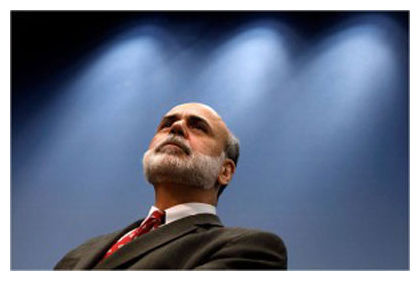
Ben Bernanke (pictured to the LEFT), Alan Greenspan, and various other bankers vehemently opposed the audit and lied to Congress about the effects an audit would have on markets. Nevertheless, the results of the first audit in the Federal Reserve’s nearly 100 year history were posted on Senator Sander’s webpage earlier this morning.
What was revealed in the audit was startling:
$16,000,000,000,000.00 had been secretly given out to US banks and corporations and foreign banks everywhere from France to Scotland. From the period between December 2007 and June 2010, the Federal Reserve had secretly bailed out many of the world’s banks, corporations, and governments. The Federal Reserve likes to refer to these secret bailouts as an all-inclusive loan program, but virtually none of the money has been returned and it was loaned out at 0% interest. Why the Federal Reserve had never been public about this or even informed the United States Congress about the $16 trillion dollar bailout is obvious – the American public would have been outraged to find out that the Federal Reserve bailed out foreign banks while Americans were struggling to find jobs.
To place $16 trillion into perspective, remember that GDP of the United States is only $14.12 trillion. The entire national debt of the United States government spanning its 200+ year history is “only” $14.5 trillion. The budget that is being debated so heavily in Congress and the Senate is “only” $3.5 trillion. Take all of the outrage and debate over the $1.5 trillion deficit into consideration, and swallow this Red pill: There was no debate about whether $16,000,000,000,000 would be given to failing banks and failing corporations around the world.
In late 2008, the TARP Bailout bill was passed and loans of $800 billion were given to failing banks and companies. That was a blatant lie considering the fact that Goldman Sachs alone received 814 billion dollars. As is turns out, the Federal Reserve donated $2.5 trillion to Citigroup, while Morgan Stanley received $2.04 trillion. The Royal Bank of Scotland and Deutsche Bank, a German bank, split about a trillion and numerous other banks received hefty chunks of the $16 trillion.
“This is a clear case of socialism for the rich and rugged, you’re-on-your-own individualism for everyone else.”- Bernie Sanders (I-VT)
When you have conservative Republican stalwarts like Jim DeMint(R-SC) and Ron Paul(R-TX) as well as self identified Democratic socialists like Bernie Sanders all fighting against the Federal Reserve, you know that it is no longer an issue of Right versus Left. When you have every single member of the Republican Party in Congress and progressive Congressmen like Dennis Kucinich sponsoring a bill to audit the Federal Reserve, you realize that the Federal Reserve is an entity onto itself, which has no oversight and no accountability.
Americans should be swelled with anger and outrage at the abysmal state of affairs when an unelected group of bankers can create money out of thin air and give it out to megabanks and supercorporations like Halloween candy. If the Federal Reserve and the bankers who control it believe that they can continue to devalue the savings of Americans and continue to destroy the US economy, they will have to face the realization that their trillion dollar printing presses will eventually plunder the world economy.
The list of institutions that received the most money from the Federal Reserve can be found on page 131of the GAO Audit and are as follows..
Citigroup: $2.5 trillion ($2,500,000,000,000)
Morgan Stanley: $2.04 trillion ($2,040,000,000,000)
Merrill Lynch: $1.949 trillion ($1,949,000,000,000)
Bank of America: $1.344 trillion ($1,344,000,000,000)
Barclays PLC (United Kingdom): $868 billion ($868,000,000,000)
Bear Sterns: $853 billion ($853,000,000,000)
Goldman Sachs: $814 billion ($814,000,000,000)
Royal Bank of Scotland (UK): $541 billion ($541,000,000,000)
JP Morgan Chase: $391 billion ($391,000,000,000)
Deutsche Bank (Germany): $354 billion ($354,000,000,000)
UBS (Switzerland): $287 billion ($287,000,000,000)
Credit Suisse (Switzerland): $262 billion ($262,000,000,000)
Lehman Brothers: $183 billion ($183,000,000,000)
Bank of Scotland (United Kingdom): $181 billion ($181,000,000,000)
BNP Paribas (France): $175 billion ($175,000,000,000)
and many many more including banks in Belgium of all places
View the 266-page GAO audit of the Federal Reserve (July 21st, 2011):
Federal Reserve Chairman Ben S. Bernanke participated in a live webcast of a town hall meeting with educators on Thursday, September 30, 2010 from 2:30-3:30 p.m. EDT. During this session, Chairman Bernanke answered teachers’ questions about the Federal Reserve and the economy.

Please Feel Free To Share This Link: /economy/2012/09/first-audit-in-the-federal-reserves-nearly-100-year-history-were-posted-today-the-results-are-startling-2449770.html

Monday, August 20, 2012

ROTHSCHILD AND ROCKEFELLER FAMILIES TEAM UP FOR SOME EXTRA WEALTH CREATION

The Rothschild and Rockefeller families have teamed up to buy assets from banks and other distressed sellers in a union between two of the best-known names in financial history.


RIT Capital Partners, which is chaired by Lord Rothschild, has taken a 37pc stake in Rockefeller Financial Services, the family’s wealth advisory and asset management wing. It has snapped up the holding from French bank Société Générale for less than £100m.
The transatlantic alliance cements a five-decade acquaintance between the now ennobled Jacob Rothschild, 76, and David Rockefeller, 96, the grandson of the ruthlessly acquisitive American oilman and philanthropist John D Rockefeller.
The two patricians now plan to capitalise on their family names to buy other asset managers or their portfolios, using their networks of top-notch contacts to ensure they get a seat at the table for any deal.
“We’ve known each other for a long time, they have a good business,” said Lord Rothschild yesterday. “We haven’t got a presence in the US and this brings together two formidable names in finance.”
He said the two firms planned to capitalise on current market conditions where banks, like SocGen in this instance, are selling non-core assets to rebuild capital ratios. “At a time when big banks are destabilised, there may well be opportunities,” he said. “We could buy an asset management company or grow one. Rockefeller already has $34bn (£21.9bn) assets under administration.”
He said David Rockefeller was still “very involved” in the business, though it is run day to day by chief executive Reuben Jeffery.
The Rockefeller group goes back to 1882, set up to invest the family money made by John D Rockefeller’s Standard Oil, the forerunner for today’s Exxon Corporation, which he built with a Darwinian aggression. “Do you know the only thing that gives me pleasure? It’s to see my dividends coming in,” he once said.
The Rothschild banking dynasty has its roots in the 18th century when Mayer Amschel Rothschild set up a business in Frankfurt.
Lord Rothschild fell out three decades ago with his cousin Sir Evelyn de Rothschild, who then ran the UK branch of the family bank NM Rothschild. That sprang to fame in 1815 when it bought government bonds in anticipation of Napoleon’s defeat at Waterloo.
Lord Rothschild’s relations with the French side of the family have been better though and he likened the Rockefeller deal to RIT’s tie-up earlier this year with the Edmond de Rothschild Group, which has €150bn (£120bn) under management.
“We think that having that span of interests in Europe and America – as well as China – will give us a better chance of finding exceptional investment opportunities,” he said.
RIT, which has net assets £1.9bn, has had a tricky few months with the shares down about 14pc in the past year. They fell 6 today to £11.25.
Lord Rothschild said: “Everyone has been marked down. We didn’t have a brilliant year on the quoted side but we did do very well on the private side,” realising investments in North Sea operator Agora Oil and Gas and credit manager Harbourmaster.
http://www.telegraph.co.uk/finance/newsbysector/banksandfinance/9300784/Rothschild-and-Rockefeller-families-team-up-for-some-extra-wealth-creation.html

GEORGE SOROS SAYS GERMANY HAS THREE MONTHS TO SAVE THE EUROZONE

George Soros, the billionaire investor, has warned Germany it has three months to save the eurozone or risk the destruction of the European Union and a “lost decade”.

George Soros says Germany has three months to save the eurozone
George Soros, the billionaire investor, said Germany would do the least required to save the euro Photo: AP
Speaking at a conference in Italy Mr Soros said the eurozone’s fate lay firmly with Germany, which he urged to agree to measures which would help the region’s ailing banking system and ease borrowing costs among the most troubled member states.
“In my judgment the authorities have a three months’ window during which they could still correct their mistakes and reverse the current trends,” he said.
“By the authorities I mean mainly the German government and the Bundesbank because in a crisis the creditors are in the driver’s seat and nothing can be done without German support.
“In the 1980’s Latin America suffered a lost decade; a similar fate now awaits Europe. That is the responsibility that Germany and the other creditor countries need to acknowledge.”
Mr Soros, who famously made $1bn betting against the pound in 1992, said the Greek crisis would come to a head this autumn.
He argued that although Greek voters were likely on June 17 to elect a government prepared to abide by the austerity terms required to qualify for future bailout funds, the terms would ultimately prove impossible to meet.
“No government can meet the conditions so the Greek crisis is liable to come to a climax in the fall. By that time the German economy will also be weakening so that Chancellor Merkel will find it even more difficult than today to persuade the German public to accept any additional European responsibilities. That is what creates a three months’ window.”
Arguing that the eurozone crisis “threatens to destroy the European Union”, he said the region’s banks would need a European deposit scheme in order to stem the capital flight already evident.
He also supported Spain’s call for the banks to be able to access direct financing from the European Stability Mechanism, the bailout fund, and said heavily indebted countries would need relief on their financing costs.
There are various ways to provide it but they all need the active support of the Bundesbank and the German government.”
Spanish borrowing costs have spiked to unsustainable highs during the crisis while German borrowing costs are at record lows as investors rush to place their money in the safest place.
France, Italy and Spain are in favour of the introduction of so-called eurobonds, which would essentially pool the debt of all eurozone members, spreading risk, but Germany is strongly opposed to the idea.
Mr Soros said that while an orderly break-up of the euro could be possible “in a few years’ time”, the likelihood was that it would survive because a collapse would come at too high a price for Germany.
He said Germany would be left with large unenforceable claims against the periphery countries, with the Bundesbank alone having over a trillion euros of claims against other central banks by the end of this year.
“So Germany is likely to do what is necessary to preserve the euro – but nothing more.” He said Europe would ultimately become “a German empire with the periphery as the hinterland.”
http://www.telegraph.co.uk/finance/financialcrisis/9308964/George-Soros-says-Germany-has-three-months-to-save-the-eurozone.html